Paleography with Medieval and Early Modern Scripts
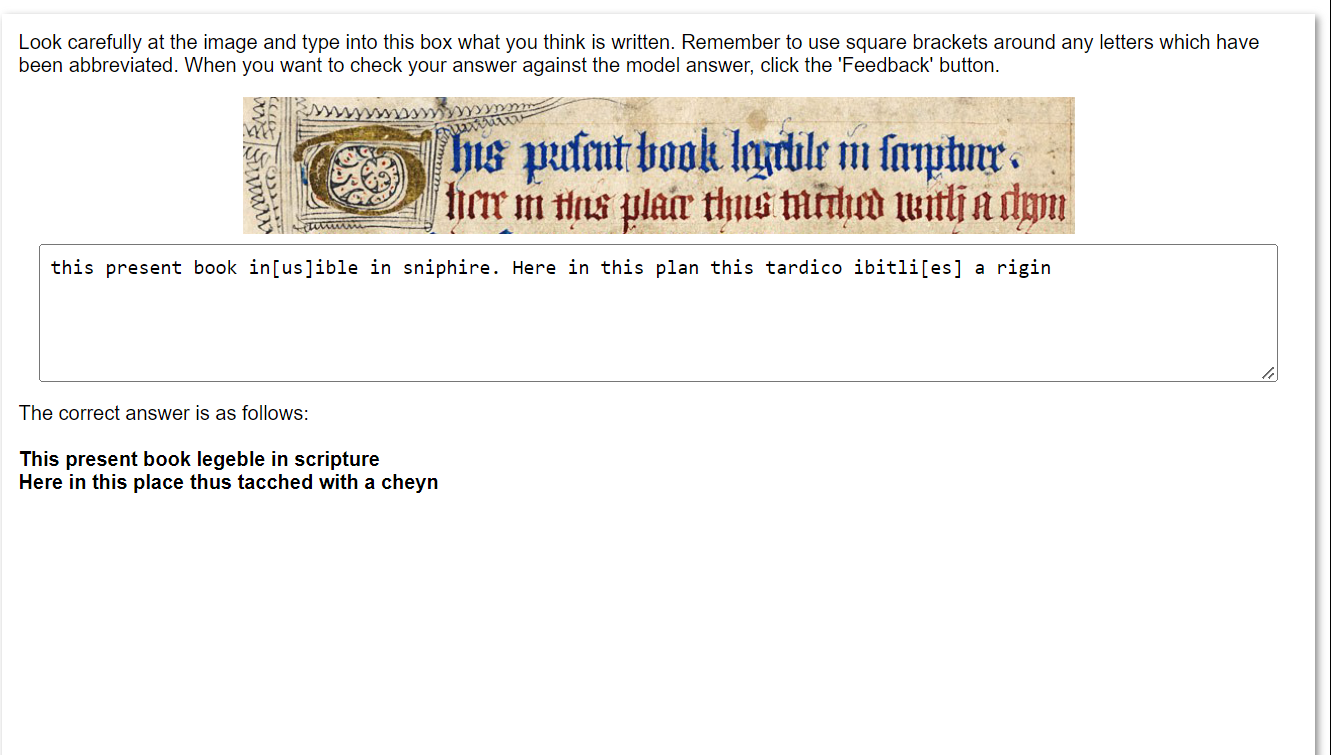
For this exercise we were tasked with studying some of the conventions of medieval handwriting and transcription. From there, we tried our hand at transcribing short medieval texts with the University of Nottingham’s interactive palaeography exercises. While I generally found the excerpts in textura script easier to interpret than those in cursive hands, both were extremely difficult for me, and I rarely transcribed more than a few words accurately. Besides textura vs. cursive, one of the biggest factors in my ability to transcribe a text was the amount of context I had for it; excerpts with names and roman numerals were very difficult since those items were not guessable from context, whereas an exercise such as the first one below was slightly easier, though still not easy!
The exercise also led me to a reflection on how I react to medieval handwriting and how my reaction is likely different from those who actually used it in medieval times. I realized as I was doing these exercises that I’ve always just assumed that medieval handwriting was inherently more difficult to read than the modern handwriting I’m used to, which seems doubtful in reality – if handwriting had been impossible for everybody to interpret, it likely would have evolved faster than it did. This realization of my subconscious orientation towards historical technologies as inferior also laid the groundwork for further reflections on other exercises, such as quill making.
See below for screenshots of two exercises. The first one, written in textura and with some context, was much easier. The second, in cursive and featuring names, was almost impossible.


Leave a Reply