Fasciculus Temporum
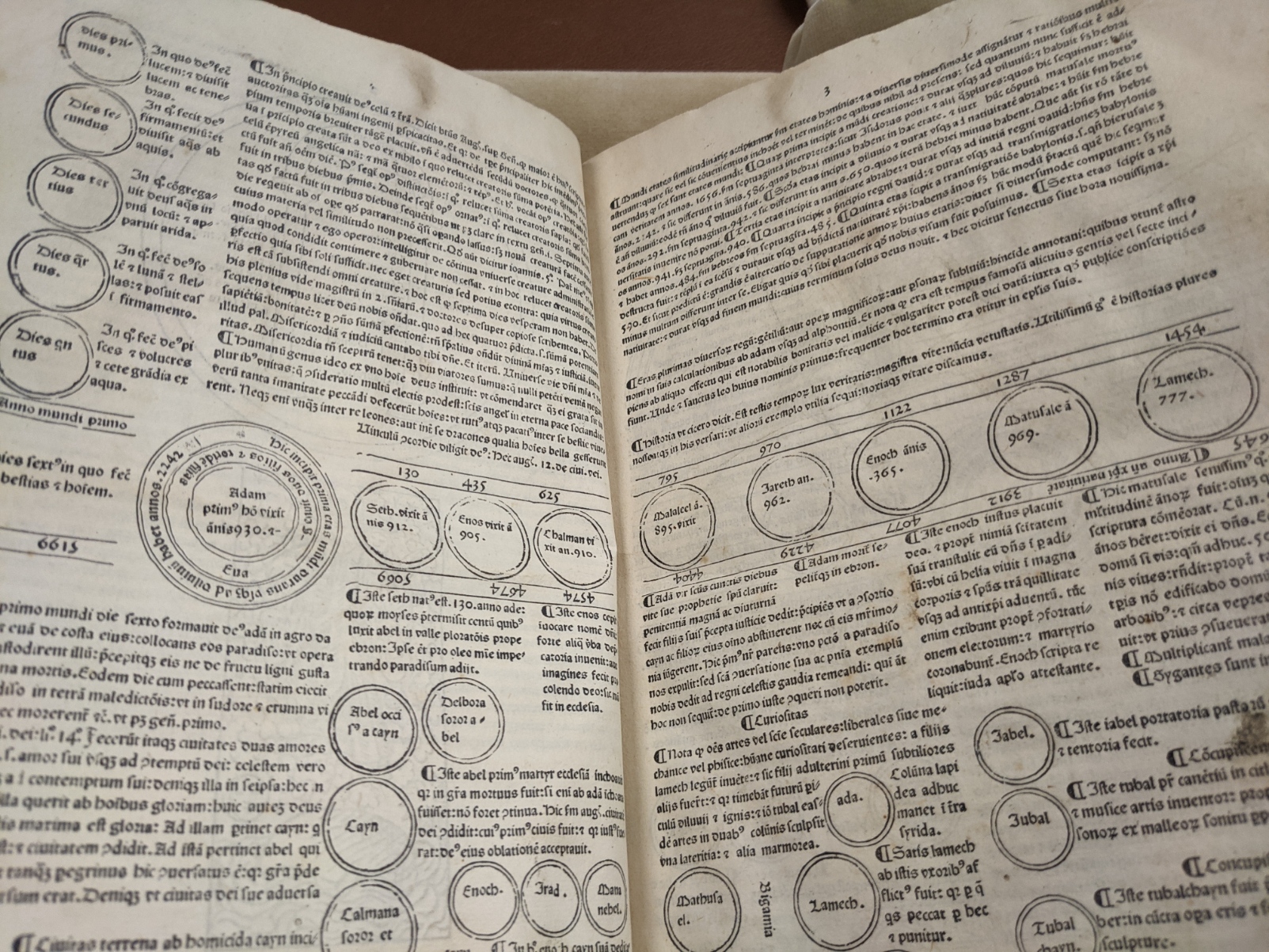
Fasciculus Temporum by Werner Rolvick was one of the best-selling books of the 15th century and probably the best-selling work of the time by a living author. The book was published in at least 33 editions by one printer in Cologne Germany, Author Ther Hoernen starting in 1474. The edition held in the Carleton Specifcal Collections has been well-used sand preserved to the modern-day. As a reference text, the book was likely read by a number of people over the years and they left their marks in marginalia and attempts to conserve the text.
The title translates to “Bundle of Dates” and the codex does just that, chronicling history starting with the biblical creation story and including both biblical stories, the history of Rome, and a papal history. The book begins with an index which is organized alphabetically and refers to page numbers. The history is arranged along with two timelines which began with “anno domini primo” or “first year of our lord” and count down to Jesus’ birth and “Christus nalcit anno mundi” which starts at 5200 and counts up. Along the timeline are arranged bubbles that highlight important events and people. Larger events get larger bubbles and each page is also filled with descriptions of the time period. Non-text elements and images are included as woodcut prints and many images are repeated throughout the text. The index, bubbles, and repeated imagery make the book easy to scan through looking for specific information which speaks to its role as a reference text.
Books don’t survive over 500 years of history without some signs of age. This codex clearly weathered pages, stained with years and years of use. Bookworms made their home in the pages at some point, leaving behind their tell-tale holes. One page was ripped badly and repaired by some questionable conservation techniques. Other strips of paper were used like bandaids to hold the ripped page together. This repair would be considered outdated and irresponsible today as it is extremely visible and nonreversible.
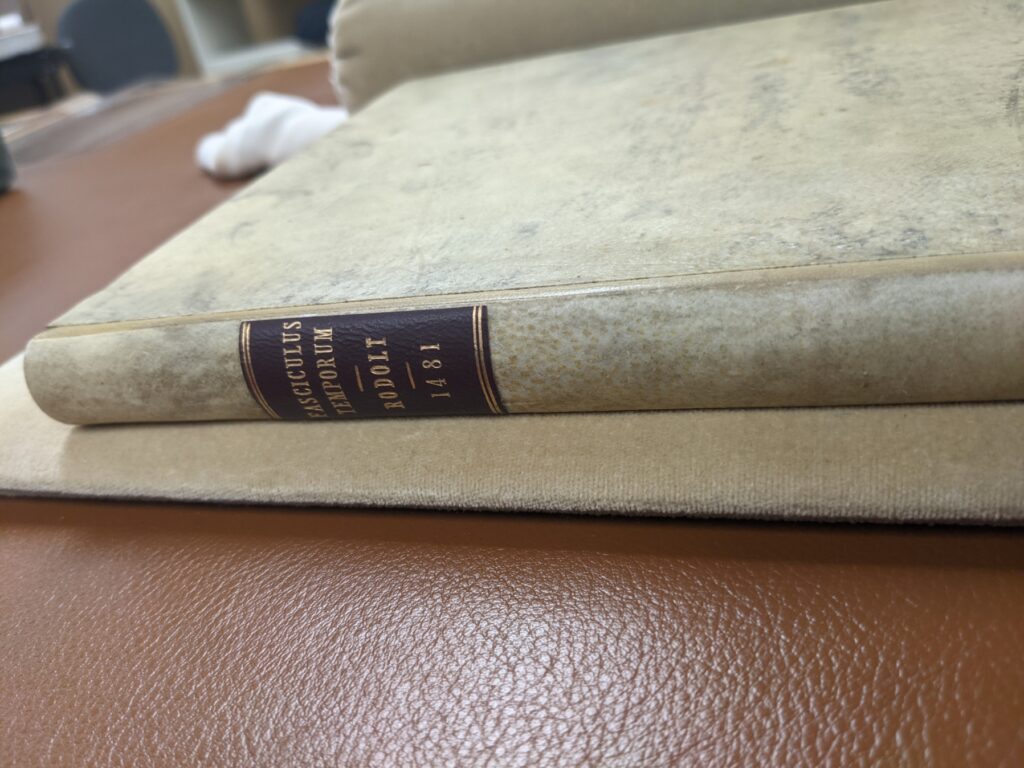
This edition bears evidence of other attempts at conservation, specifically in the binding. The binding on this edition is not consistent with the period-accurate binding which would have clear stitching holding bundles of folios together and would not have a covered spine. The style of binding on this edition is more modern case binding, with each gather attached to a ribbon and then a complete spine. There is also a slight texture change at the connection of covers and spine, that the book was rebacked at some point. This procedure is normally done to save covers when the binding is no longer holding them adequately and allows the book to retain some original features. Rebecca seemed to think that the covers weren’t original to the book so the rebinding and rebacking effort may have happened at different times and may represent multiple attempts at conserving this edition. This edition is also missing both a title page and a final colophon. From a research perspective, this is frustrating because these pages might contain useful information on the author, printer, or editor of a text. These missing pages further support a rebinding effort on the text, during which these pages were removed for some reason. These conservation attempts show that the book was highly valued enough to invest time and resources into keeping it in good condition.
Another change to the binding was the addition of a handwritten page which seems to be a copy of a missing page. Although this page seems incorporated into the binding, there is no matching entry elsewhere to indicate the other half of the folio. This page uses a similar format to the printed pages in the book, focusing on a timeline and mimicking the bubbles of information. This matching leads me to wonder if the writer of this page was copied from either the removed page or the same page in a different edition. This page does contain a drawing that does not appear anywhere else in the text nor in a digital facsimile from a year after this edition was published. This drawing represents some creative impulse from the person adding the new page.
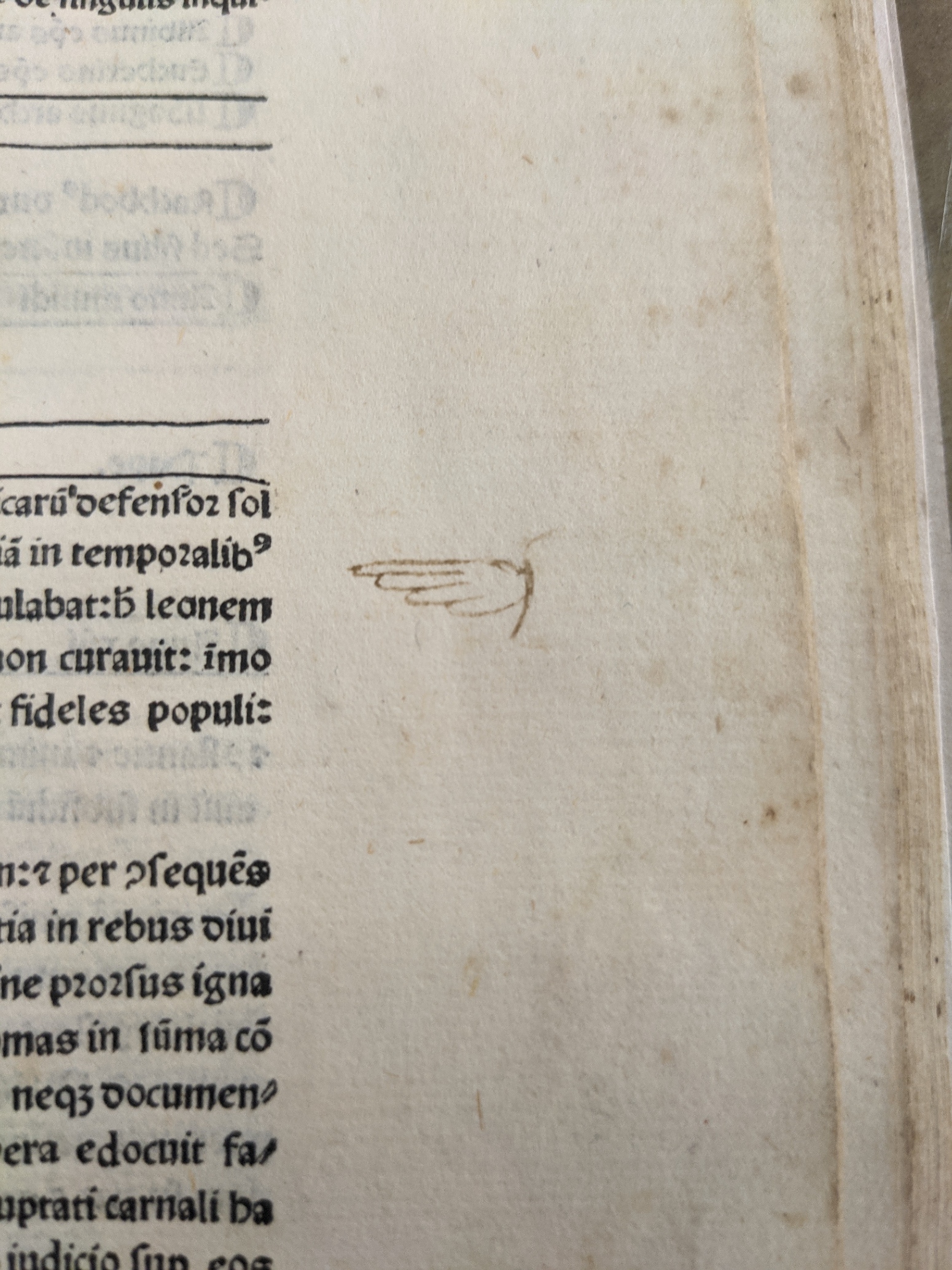
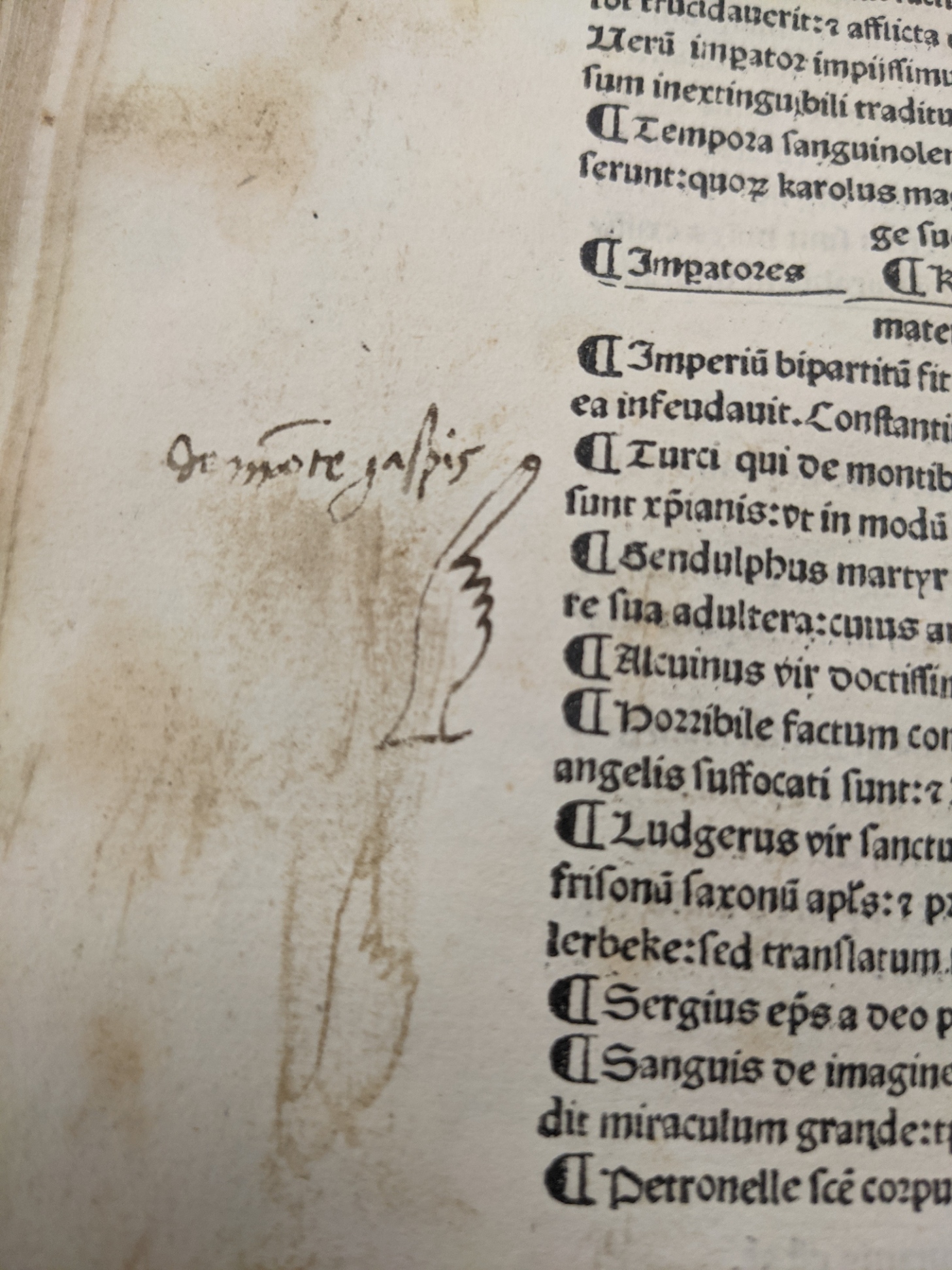
The creative impulse of one of the owners of the text can also be seen in the marginalia of the codex. Small hands, known as manicals decorate the text, pointing to specific quotes and important information that the reader wanted to highlight. In this edition the hands seem rather inconsistent which makes me wonder if they were added by a number of different readers or at different times, indicating the book was passed around or reread repeatedly.
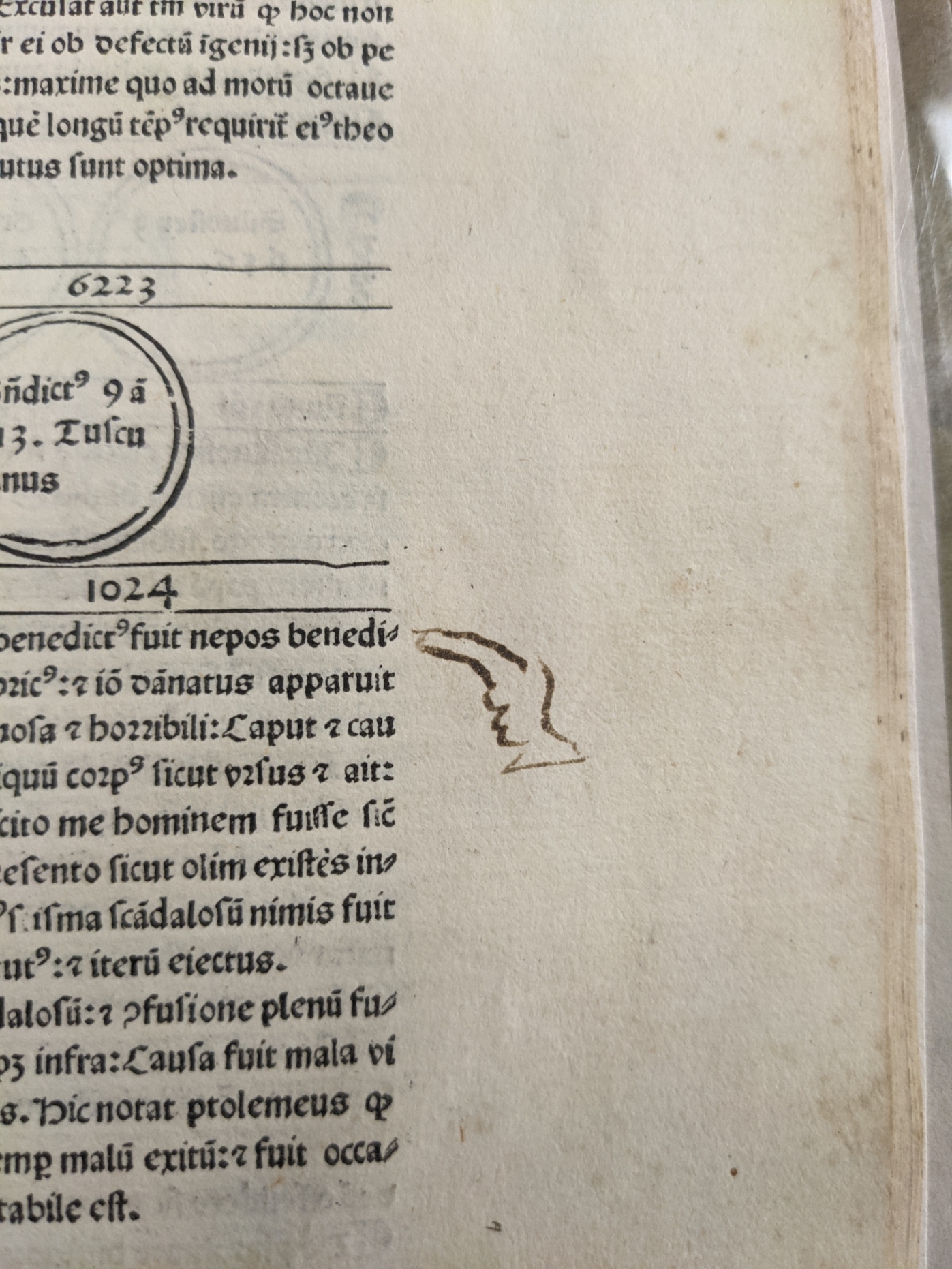
The effort to conserve and handwritten replacements show how much value was put into this edition. It was likely reread countless times as it was passed from reader to reader and there is evidence of multiple attempts to keep the book in the best condition possible (even if these attempts were misguided). The presence of a table of content and the use of highlighted information in text bubbles imply that the book was used as a reference text, rather than being read like a novel.
Works Cited
Rolevinck, Werner. Fasciculus Temporum. Arnold Ther Hoernen, 1474, University and City
Library of Cologne: Digital Collection, https://www.ub.uni-koeln.de/cdm/compoundobject/collection/inkunabeln/id/203380, Accessed 10 May 2022.
“‘Fasciculus Temporum,” Probably the Best-Selling 15th Century Printed Book by a Living Author.” “Fasciculus Temporum,” Probably the Best-Selling 15th Century Printed Book by a Living Author. : History of Information, https://historyofinformation.com/detail.php?id=3240.

Leave a Reply