Paleography Exercises
According to the Oxford English Dictionary, paleography is “[t]he study of ancient writing and inscriptions; the science or art of deciphering and interpreting historical manuscripts and writing systems.” In the digital age, you don’t have to be a scholar of ancient writing systems to try your hand at deciphering historical manuscripts, which is exactly what we did through online resources provided by the University of Nottingham and the University of Cambridge.
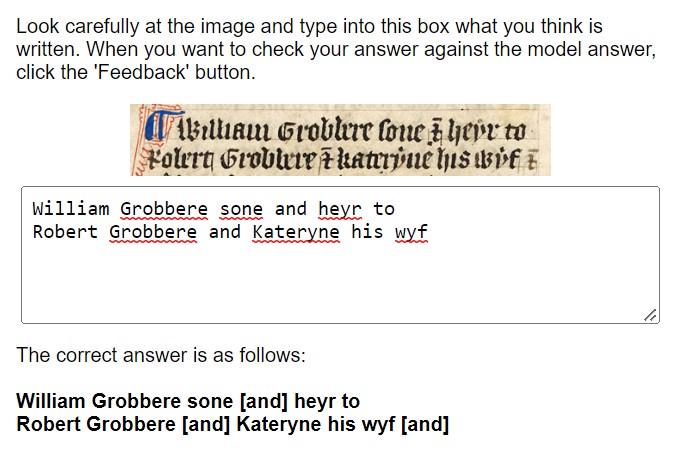
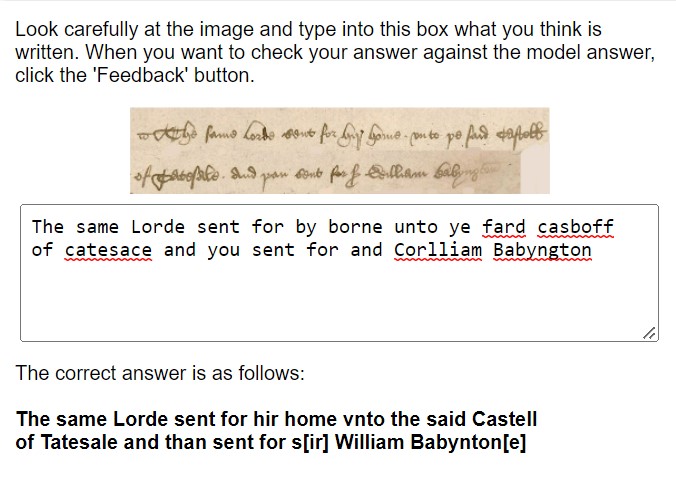
The former began chronologically with Textura script, a bold, uniform, and linear font from the Middle Ages that reflects the pointed arches of Gothic architecture. The regularity of Textura helped me decipher the excerpts and when in doubt, I could count the vertical strokes or minims to figure out a word. However, as the writing styles progressed from medieval to the early modern Secretary script, letters started to blend into each other, vary in size, and extend above and below the writing line, making transcription more difficult. The antiquated spellings of earlier documents were joined by new characters and abbreviations. For example, I was confused by the letter thorn, which looks very much like a ‘y’ but is pronounced ‘th’ (hence the phrase “ye olde” which was really just “the olde”). These exercises affirmed the importance of scribes and editors in minimizing errors that change the meaning of a text. Such errors lead to differences between versions of a work that bring up questions about an author’s intent and which texts provide the best basis for producing new versions.

Leave a Reply